
Modul 3 - Økt 1
1Introduksjon og læringsutbytte
HTMLOrganisatoriske aspekter — Velkommen til økt 1
I denne økten presenterer vi de seks sentrale organisatoriske områdene som må vurderes, og utforsker hvordan de kan håndteres i en PLF gjennom informasjonsinput, praktiske øvelser og refleksjonsmuligheter. Vi starter med to sitater …
Sitat 1:
"Den som hver morgen planlegger the transaction av day og follows out that plan, carries a thread that will guide him gjennom the maze av mest busy life." Victor Hugo (in Maxwell, 2000, p.182)
Sitat 2:
"A good plan is like a road map: It shows the final destination og vanligvis the best way to get there.“ (H. Stanley Judd)
Disse to sitatene fremhever betydningen av organisatoriske aspekter for arbeid generelt og påpeker at å håndtere dem skikkelig bidrar til suksess. They kan være related til approach of PLF work. In PLF participants care very mye about deep refleksjon og development of nye ideer for their praktisk work. By også taking care of organizational aspects the gruppe supports sin egen collaboration. If organizational aspects are deliberately planned – for example, av gruppe setting structures regarding tid, møter, og prosesser, og by anticipating the recording of results og achievements – noen decisions are already made for members later i prosess og no longer need to be diskutered. When a gruppe pays attention to organizational aspects they sørg for, distraction, inefficient exchange or unpleasant situations are reduced.
2Oversikt over organisatoriske aspekter ved PLF
HTMLThe pie chart nedenfor illustrates all aspects to be vurdered in the organizational dimension og comprises six sections

3Beskrivelse av organisatoriske aspekter ved PLF
HTMLPie chart description:
1. Tid management: Regarding tid management, the gruppe focuses on using tid optimally, working as efficiently as possible to maximize benefits for everyone i den tiden. This is ensured by generally pre-structuring the sessions og providing an agenda that gives an overview of hva to expect. Having a generelt fixed tid frame helps members work together in a disciplined og focused way, fordi everyone knows the procedures og no tid is lost on diskuterions due to uncertainties.
2. Room & materials: Preparing the room og materials serves as an external structure that helps the PLF focus på content-related topics. This også establishes additional conditions relevant for møte, allowing the tid to be devoted til actual exchange. The quality of the exchange og everyone’s ability to participate i diskuterion are influenced by the room’s setup. The room design også fosters a sense of well-being når it is welcoming og inviting. Materials, in turn, clarify the prosess og tasks, encourage participation, og enable interaction in various ways.
3. External & internal communication: Organizational agreements også concern who outside the gruppe is informed about which aspects av gruppe’s activities og how the gruppe fundamentally intends to structure internal communication innenfor PLF. This clarifies who should be contacted regarding the gruppe, og hva information may be communicated externally, og hva should remain confidential. Communication management også includes deciding in advance who should be informed about what and via which channels, as well as jointly determining how mye the PLF presents itself for promotional purposes.
4. Working methods: Aktiviteter specifically used i PLF work can vary widely, men they alltid først establish a specific framework for collaboration og exchange. Various methodological setups help to engage in fast og diverse conversations, stay aware of tid constraints, introduce topics spontaneously uten losing focus, og visually organize diskusjonen. Working methods enable flexibility og variety, provided they are chosen deliberately for å tilpasse the purpose. Der are også basic working methods in a PLF that occur in hver session.
5. Prosess quality: Organizational aspects kan også help enhance the prosess quality av en PLF. Primarily by permanently incorporating the ‘bird’s-eye view‘, meaning ongoing meta-communication. This allows members to track sin egen development og keep an overview av exchange prosess som whole. Moreover, such monitoring elements support elements like mål setting, turning mål into planned steps, and ultimately evaluating om the expected results har vært achieved. For these monitoring steps, methods that are used on a regular basis are suitable.
6. Documentation: Since PLF are designed for the long term og members meet again etter noen tid apart, documenting hva has been developed og agreed upon er en viktig aid to remembering. Organizational elements for eksempel clear documentation practices, archiving, communication channels, og quick sharing methods are essential for seamless collaboration og for actual exchange of knowledge captured in writing or visuals, alongside verbal knowledge. They også help participants quickly get back on topic at neste møte. Also, thanks til possibility of using digital verktøy, documentation kan være thorough yet tid-efficient.
4Viktig å vite 💡
HTML💡
The aspects of the individual components av organizational dimension er ikke mutually exclusive; instead, the organizational elements ofte overlap or directly connect med hver other. To provide clear learning og refleksjon steps, and thus simplify orientation, we follow the established distinction.
Om you start working med a PLF or vurder organizational aspects throughout the tid spent together, der are carefullt ut developed activities specifically designed feller koordinerer organizational aspects together. They are structured like a møte guide og kan være used directly av tilrettelegger med a gruppe or, if needed, carried out independently av gruppe following the instructions. These activities were også developed i LeaFaP project og complement the training.The activities take approximately 1.5-2 hours to complete. They include several sub-tasks in which the gruppe examines og analyzes its current organizational practices, vurders possible improvements og actively implements them. Furthermore, worksheets og exercise templates are available.
5Flere aktiviteter på nettstedet vårt
HTML1. The først activity in the organizational dimension kan være used by a PLF that has already held a få active sessions but is still i early stages of its development, or by a PLF that has never vurdered this before, regardmindre of how long they har vært cooperating.
https://www.leafap.eu/wp-content/uploads/2025/06/12_Organizational_English.pdf

2. The andre activity can be used once the gruppe has planned its organizational initiatives og has attempted to implement a få sessions. It then focuses on reflecting på implementation
https://www.leafap.eu/wp-content/uploads/2025/06/13_Organizational_English.pdf

6Aspekter: Tid/Rom og Materiell
HTMLTid & Room/Material


When it comes to conducting a PLF møte, der are mange details that need to be vurdered. This includes both the internal og external structure of the session. That’s why you have to be prepared. The først exercise focuses on fundamental vurderations for en PLF session, highlighting aspekter som er essential both i preparation og i facilitation of the møte. The following er en conversation between two PLF-medlemmer who are talking etter a PLF session og were dissatisfied med how it went. Lytt til the audio file og think about how du ville håndtere the situation. Du kan pause the file and take notes as you go.
7Lyd 1: Samtale rett etter en PLF-økt (engelsk)
M4A8Løse problemer ✏️
HTML✏️ Lytt til the andre dialogue og think about which ideas du kan apply.
9Lyd 2: Samtale etter diskusjon (engelsk)
M4A10Sjekkliste
HTMLCheck list
11Fordypning i rom og materiell
HTMLRoom & Material
Etter diskutering the key aspects that are viktig for conducting a PLF session, we now turn our attention to the møte stempo og its equipment. In this prosess (or a similar one) in mind, it is helpful to have essential materials on hand for hver session. We have prepared a PLF møte room in which five colored rectangles in red, blue, orange, purple og green indicate different room zones. The images contains different types of materials which we vurder to use i en PLF-Session og which are are assigned to hver area av room. Of course du kan brukese ideas i en PLF-møte or a different møte situation.

1. The tilrettelegger’s spot: Talking ball, clock, computer, mobile phone, summary sheets

2. The session table i center: Metaplan cards (in different colors), white paper, sticky notes, agenda, documentation material

3. A flipchart wall på side: Markers (in different colors), adhesive dots/sticky dots, poster

4. A side table: water bottles, coffee pot, biscuits, cups/glasses

5. Optional andre table: Books, further material

Hvordan envision your ideal møte space?
↪ Which insights or ideas fra denne økten will you apply in din egen gruppe?
↪ How does your chosen room setup reflect your facilitation style og the mål you want to achieve med gruppe?
↪ How can the room be shaped i en way that reflects the needs and contributions av alle members? How can the room og its design support collaboration og focus?
12Aspekter: intern/ekstern kommunikasjon og arbeidsmåter
HTMLInternal/external communication & working methods


The først section focuses on two key aspects: information-related og contact-related communication. It outlines how PLF-medlemmer exchange information, establish ground rules, og interact med hver other i en respectful og productive way.
Information-related communication
Generally, PLF-medlemmer need to agree on a få key points. These not only cover their intention to communicate om temaet men også set the ground rules for how they interact med hver other. Members også need to agree on who needs to know what, og hva they are allowed or expected to share. The questions to vurder are: Who gets which information, why, og who is the contact person for specific issues, etc.?
The moderating tilrettelegger’s task is to guide the gruppe gjennom this exchange, ensuring that all points are clarified og unresolved issues do not lead to conflicts. It is helpful to address these aspects at the beginning or etter the først få sessions, inkludert decisions required for data protection compliance.
Nedenfor er guiding questions from a checklist:
· Who needs to be informed that the PLF is working …?
· Who is our contact person for external matters …?
· Which data privacy aspects do we need to vurder …?
· How do we handle expectations of confidentiality/personal informasjon om individuals …?
· How do we want to present the gruppe externally …?
13Tilretteleggerens perspektiv i PLF — del 1
HTMLContact-related communication
In the andre section you will (1) utforsk how information- og contact-related communication shape collaboration innenfor en PLF og how you position yourself as a tilrettelegger. (2) Du kan vurder de potensielle fordelene og constraints of a specific communication choices.
1. Tilrettelegger’s perspective i PLF

“Mirror, mirror på wall… hva can I, as a tilrettelegger, actually influence, at all?“
As a tilrettelegger, du significantly influence the level of trust og samarbeid i PLFen’s communication. Som tilrettelegger you need å reflektere on what matters to you, how du kan work effectively, how you want to be addressed, the extent to which you show yourself personally, og hva slags support you want to provide.
14La oss se hvor du står 📍
HTMLRefleksjon — Slider overview
Self-positioning
Move hver slider to wher you currently stand.
Optional note (for yourself): What patterns notice across your sliders?
15Tilretteleggerens perspektiv i PLF — del 2
HTMLOnce the tilrettelegger is aware of their preferences, they can align them with the needs av PLF-medlemmer. It is helpful to vurder de potensielle benefits og constraints av en specific communication choice. The differentiation nedenfor offers noen related information. Which one choose og why?
Below vil du finnee noen check list cards: Her du kan check yourself hva you are already putting into practice og hva you want to vurder for neste økt
16Sjekklistekort
HTML
17Strukturere diskusjonen
HTMLWorking methods

In this section, du vil lære hvordan facilitation cards kan være used to structure topic development innenfor en PLF. They support a clear og participatory prosess by helping members to organize ideas, set priorities, og make collective decisions i en transparent way.
Structuring the diskuterion med facilitation cards
Using facilitation cards er en helpful way to organize samtalen og document it som whole. Nedenfor we show typical distinctions the tilrettelegger keeps in mind during diskusjonen, og arranges using appropriate facilitation cards.
The cards shown nedenfor depict a typical order av basic steps (basic differentiation) for using the facilitation cards.
Ø Heading of the chosen topic
Ø Case example
Ø Theoretical reference mentioned by a participant (if unclear, the tilrettelegger intervenes)
Ø Concept to which the idea kan være assigned
Ø Proposed option of action
Ø Study outcome that someone has heard of or introduced av tilrettelegger
Ø Topic that arises additionally men needs to be postponed (topic backlog)
Ø Proposed option of action

📍 Furthermore, a short explanatory video demonstrates how this works in practice
18Video: Strukturere diskusjonen med tilretteleggingskort (engelsk)
MP419Tips 💡
HTML💡
It is recommended that the moderator or tilrettelegger explains, i en meta communicative way, how spesielt viktig contributions or new colors/forms are applied, to give members insight inn i procedure. Først taking a photo of diskuterion circles that are largely complete, then setting them aside to free the table center (often in connection med a short break), også helps maintain an overview.
20Aspekter ved prosesskvalitet og dokumentasjon
HTMLAspekter ved prosesskvalitet og dokumentasjon


I denne delen vil du utforsk how prosess quality can be strengthened gjennom a three-phase model which kan være used i PLF or similar gruppe activities. Additionally you have the possibility to check documentation in practice.
Prosess qualities
Besides perspectives that structure single sessions, a key prosess-oriented view vurders the major milestones a PLF reaches over the course of several sessions. Der er en få steps that can initially be used to map out the trajectory av en PLF over tid. In general terms, stegene are: formation stage, practice, reinforcement, although the phases er ikke strictly distinct – noen ganger a gruppe seems to have reached neste phase men still performs behaviours that would be attributed to an earlier phase.Overall, prosess quality i en PLF relates to internal og external structures, the profesjonell og personal collaboration of its members, individual profesjonell development, og efforts to apply learning in practice. Alongside the individual og topic-related mål of the PLF, it is viktig to vurder the perspective that PLF development and establishment should be seen som prosess to be both accompanied og evaluated.
📌 Based on Bouchamma et al. (2020), we provide an example av typical prosess phases of a PLF, med contents outlined as follows. The following representation summarises the key aspects i en concise form. To do this, we først use a visualization av prosess phases.
21Tre prosessfaser i en PLF
PNG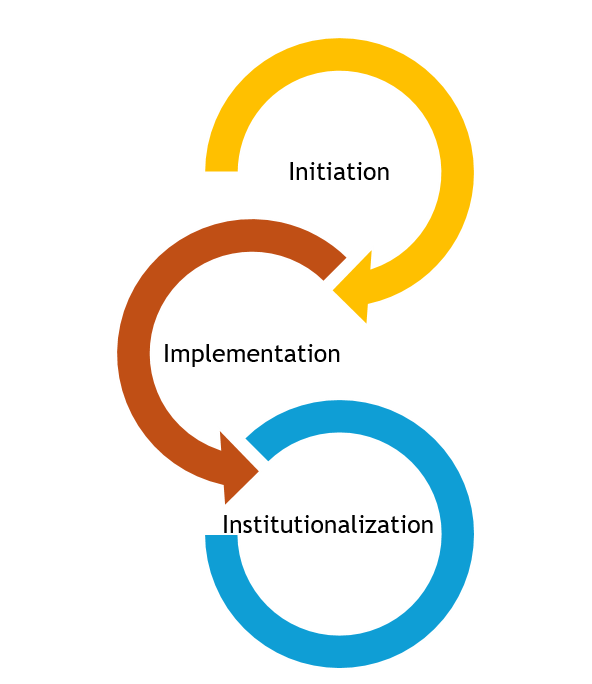
22Forklaring av tre-fase-modellen
HTML Phase
1: Initiation
Phase
1: Initiation
- Decision to establish the PLF
- Go gjennom negotiation prosesser
- Set the conditions for the PLF (regular møter, schedule)
- Addressing (individual) topics og challenges
 Phase 2: Implementation
- Getting to know new learning og working approaches (exchange among members/facilitation, drawing inspiration from others‘ examples)
- Integration of new working methods
 Phase 3: Institutionalization
(integration phase)
Phase 3: Institutionalization
(integration phase)
- The PLF is fully integrated som stable og self-sustaining part av organization
- Shared values, norms, og collective responsibility are firmly embedded in daily practice.
- Members demonstrate an ongoing, utforskning-driven mindset toward profesjonell læring og improvement
23Refleksjonsspørsmål
HTMLNow du kan spør deg selv or tenk på following refleksjon questions:
Phase 1: Initiation
For de som allerede har a PLF:
↪ How clearly were the mål, roles, og framework conditions defined at the start of our PLF?
↪ To hva extent were the interests og needs av alle members vurdered during the initiation phase?
↪ What helped å bygge trust og shared responsibility i early stage i PLFen?
For de som do ikke ennå har a PLF:
↪ Which topics or challenges i min profesjonell kontekst would be suitable for establishing a PLF?
↪ What framework conditions (tid, structure, support) would be needed to start a PLF successfully?
↪ Who i min organization might be interested in joining a PLF, og why?
Phase 2: Implementation
For de som allerede har a PLF:
↪ How effectively do we integrate new learning og working approaches into our practice?
↪ Which factors foster or hinder open exchange among members?
↪ How do we use examples og experiences from others as inspiration for our own development?
For de som do ikke ennå har a PLF:
↪ What forms of profesjonell exchange do I currently use, og how could they become mer systematic?
↪ How could I experiment med new working or learning approaches that would support a future PLF?
↪ What kinds of support (e.g., facilitation, tid, digital verktøy) would help me to initiate samarbeidende learning prosesser?
Phase 3: Institutionalization (integration phase)
For dem som allerede har a PLF:
↪ How can we recognize that our PLF is fullt ut embedded in everyday practice and organizational culture?
↪ How do we sørg for at delt kunnskap is actually applied og creates visible impact?
↪ Which structures help our PLF remain vibrant, productive, og learning-oriented over tid?
For dem som do ikke ennå har a PLF:
↪ What would a sustainably functioning PLF look like i min organization?
↪ Which values, norms, or routines would need to change for collaborative learning to become natural?
↪ How could responsibility for collective development be anchored in a lasting way?
24Dokumentere 📝
HTMLDocumentation
When dealing med documentation from a tilrettelegger’s viewpoint, it is useful to først reflect internally og vurder the questions regarding documentation i PLF. Der are several reference points to vurder regarding the PLF’s current prosesser, the documentation itself, og the evaluation of results, which også involves deciding på appropriate forms, methods og media. In the end, this concerns taking responsibility for the PLF’s quality.
Documentation innenfor PLF does not only mean taking minutter and filing or organising documents, men også includes, among other things, that:
• areas for learning og development kan være accessed.
• members receive support in planning, implementing and reviewing initiatives.
• one can easily look back at den forrige økten and also prepare for current or next one.
• it is easier to follow up on topics i next session.
• insights, lessons learned, og tested practices can be mer easily documented og revisited in daily practice.
• information, ongoing issues og plans kan være shared innenfor PLF.
• various documentation methods are familiar, organised individually, tried out og consistently applied in daily practice.
• tasks are organised, responsibilities clearly assigned, og knowledge management implemented.
25Svart får — Introduksjon og oppgave
HTML

Now it’s tid to put into practice og test. To get to know various documentation methods and distinguish which ones are unsuitable, attempt å identifisere the “black sheep“. Out of the nine images, two er “black sheep“, meaning they are mindre suitable for supportive documentation. Først, look at alle pictures og vurder which of them represent good documentation practices or examples, og which ones are mindre suitable. When you click på whole picture, the correct answer will appear: a green frame indicates a correct choice, mens a red frame shows the black sheep, which is unfortunately incorrect.
26Svart får
HTML27Svart får — Forklaring
HTMLResolution- Image Descriptions:
Image 1: A clearly structured protocol for all participants, inkludert headings, agenda items, the date, assigned tasks, og scheduled upcoming møter.
Image 2: An action Plan that is fullt ut completed, med no fields left blank. Only carefullt ut vurdered og documented entries can be reviewed, which in turn supports success.
Image 3: A flipchart med a well-structured agenda, large legible writing, various colors for structuring, og spare markers.
Image 4: A PLF folder, opened med dividers: all documents are organised in designated places, giving structure og preventing loss. In addition, the folder kan være customized med a bright color or pattern to make it easy to find.
Image 5: A shared digital workstempo (for eksempel an online Trello board) is well-structured; current events og information are displayed, and different colors are used (med a legend explaining the system they follow).
Image 6: A messy or illegible note on a piece of paper eller en page scribbled all over, lacking clear structure – chaotic, overloaded or incomplete (missing date, content not properly assigned)
Image 7: The personal workstempo or preparation for session is very minimal and sparse. It consists of just one single sheet of paper, partially filled in, med a pencil placed next to it.
Image 8: PLF journal. A small notebook or A5 pad serves as a practical documentation verktøy in daily practice. Ideas, information, og moments of realization kan være quickly recorded og easily revisited.
Image 9: Facilitation cards containing the documented content av PLF møte, so all participants can follow along visually og capture photos for minutter.
28Referanser
HTMLVidere lesning
Bouchamma, Y., Basque, M., Giguère, M. & April, D. (2020). Profesjonelle læringsfellesskap. Competency standards for skole principals. Québec, QC: Hermann/Presses de l’Université Laval.
Huffman, J.B. & Hipp, K.K. (2003). Professional learning community organizer. In J.B. Huffman og K.K. Kipp (Eds.), Reculturing skoler as profesjonell læring communites. Lanham, MD: Scarecrow Education.
Judd.,S. H. (unbekannt) goodreads. Available at: https://www.goodreads.com/quotes/8177249-a-good-plan-is-like-a-road-map-it-shows (12.08.2025)
Kansteiner, K., Welther, S., & Schmid, S. (2023). Professionelle Lerngemeinschaften für Schulleitungen und lærere. Chancen des Kooperationsformats für Schulentwicklung und Professionalisierung. Weinheim: Beltz. https://www.beltz.de/fachmedien/erziehungswissenschaft/produkte/details/48917-professionelle-lerngemeinschaften-fuer-schulleitungen-und-lehrkraefte.html
Kansteiner, K. & Welther, S. (2025). Praxishandbuch Professionelle Lerngemeinschaften in Kita und Kita-Grundschul-Kooperationen. Weinheim: Beltz Juventa. www.beltz.de/978-3-7799-8663-8
Maxwell, J.C. (2000). Failing Forward. Turning Mistakes Into Stepping Stones for Success. Nashville: HarpersCollins Leadership.